



 |
News Sourcing Successfully in the New China |

Contact Us
Enquiry
Request for Quote
Request Commodity AP
News
China Import and Export Fair
Ready For the Next Sourcing Wave?
Sourcing in Asia 101
Sourcing Successfully in the New China
Back in April, Logistics Management and Accenture collaborated on an article entitiled "Right Shoring: A flexible supply chain strategy for though times." The story's premise was that operational excellence stems most directly from a company's ability to react quickly -but not impulsively- to global market changes and macroeconomic shifts. Using sourcing to make our point, we explained that blending on-shore, near-shore, and far-shore operations often serves companies better than acquiring materials solely from distant, low-cost countries.
One case example was China, whose sourcing profile is somewhat different from several years ago. Contributing to the country's ongoing advantage are immense manufacturing capacities and labor availability as well as low (albeit rising) labor costs. However, China's productivity levels are also lower, which neutralizes the labor advantage somewhat.
In addition, North American and European companies are discovering that sourcing solely from distant venues (such as China) can over-expose them to the brutal effects of fluctuating oil prices and unpredictable currency swings. Monolithic far-shore sourcing strategies also make it difficult to respond quickly to rapid shifts in customer demand. Together, these realizations have begun to change how China is positioned in the global sourcing saga.
However, the april article did not touch on the many changes engendered by the above shifts. Are more U.S. and European companies finding alternatives to China-based sourcing? And what are the supply chain management implications for companies with China-focused sourcing investments or aspirations? Following are some insights and ideas.
China Remains A Tier One Supplier
No company or country maintains an indefinite, unassailable competitive edge; and China is no different. For a while, China seemed to come about as close as any country ever has to being a one-stop shop. But things have changed and to its credit, China is adapting.
As shown in Figure 1, labor-intensive items such as clothing and textiles used to represent the bulk of products sourced from China. Today, products with higher technology content are among its top exports. However, even with these shifts, it's imperative to remember that China's role as a critical worldwide source of goods and materials is not in jeopardy.
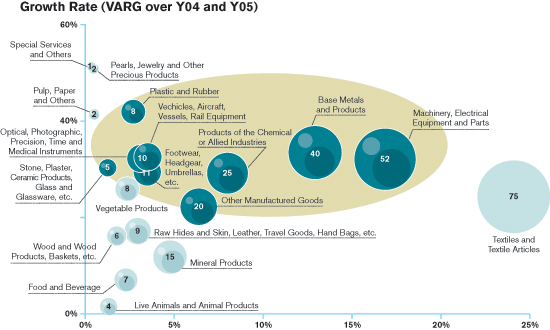
Companies, customers, and commodities come and go, but China continues to be one of the best and most robust sourcing opportunities there is -with plenty of opportunities and solid players. Consider five reasons why China represents as large (or larger) a sourcing opportunity as ever before:
- Dips in the global economy have left China with a lot of excess manufacturing capacity (50 percent or more in some industries). This could make now an excellent time for global companies to step up sourcing activities. Compare the situation to a down stock market, which is often the ideal time to buy strong but undervalued companies.
- Dramatic overcapacity also exists in ocean freight. Hundreds of vessels are currently floating fallow in Hong Kong's harbors. No one expects this situation to turn around quickly, which means the time could be right to lock in ocean shipment contracts.
- China's market (domestic) growth is about as promising as any economy in the world. Most companies' sourcing decisions need to consider these growth prospects, along with the potential to serve those markets with easily available components and materials (i.e., those sourced in China or therabouts).
- Although China's labor costs are rising, they are still significantly cheaper than Western countries. Moreover, increasing labor costs may be suppressed by China's constant push toward the establishment of new resources and facilities in outlying areas of the country -where labor costs are naturally lower. The challenge, of course, is that obtaining goods from more rural communities in China adds more time and distance to the sourcing equation.
- Most of China's leading suppliers have dramatically improved their product/services quality by implementing control mechanisms and systems, renewing manufacturing lines, and increasing the talent pool. Chinese companies are more open to continuous imprevement methodologies as well as collaboration within and across industries, with overseas partners, and with third parties. This receptivity to teamwork and improvement clearly makes China more desirable from a sourcing perspective.
Trends in Successful Sourcing
China's role as a premier source of components and materials may not be in jeopardy. However, the evolution of global business and the tenuous state of the world economy demand that western companies reexamin their sourcing strategies and operations in China.
One reason is that a fair number of Chinese suppliers have been hurt by customer bandruptcies or (somewhat less lethally) customers' inability to pay on time. As a result, some Chinese suppliers are demanding more stringent payment terms, particularly from new customers.
Other suppliers, however are seeking to attract customers by taking a more flexible approach to payment terms. No matter which way a supplier is inclined, it strongly behooves buyers to understand the financial health and evolving policies of suppliers.
Price negotiations with Chinese suppliers also require high degrees of sophistication and preparation. Irrespective of their China-sourcing experience, companies should ensure that contracts and proposed changes are well-researched (fact-based) and sustainable. Obtaining short-term price reductions from a Chinese supplier without any commitment to a long-term partnership will increase the ristk of the supplier walking away from an agreement when the economy turns around.
Tools such as price indexing (allowing limited periodic changes in line with raw material prices) can be very effective in this context. However, there are still many Chinese suppliers that are not well-versed in price-indexing on contracts. Prospective customers should be ready to provide detailed explanations and illustrations of price-indexing to demonstrate its win-win potential.
This may also be a good time to consider working with highly reputable, large logistics providers. Entities like DHL, FedEX, and UPS are structured to help businesses of all sizes source quickly and reliably. And the added costs associated with not doing it yourself are largely neutralized by reduced assets and overhead as well as the likelihood of achieving greater convenience, reliability, security, consistency, and scalability.
Moreover, transport costs within and out of China are relatively low and represent only a small portion of total landed costs when shipping globally. All told, the incremental cost-bump associated with a top-quality third party is relatively small.
Companies seeking a major sourcing presence in China may also wish to develop international procurement organizations (IPOs) rather than accept the limitations generally associated with less-effective trading agents, joint ventures, and wholly owned foreign enterprises. Think of IPOs as extensions of a company's global procurement organization -shared services entities staffed with specialized sourcing teams that also perform dedicated order- and logistics- management functions.
IPOs often represent a company's best chance to reduce sourcing costs and limit sourcing cycle times. They also put local capabilities "on the ground," ensuring greater proximity to supply markets and better responsiveness to local opportunities. Plus, the presence of an international procurement organization helps guarantee that all forms of procurement information are communicated to corporate business units worlwide.
Permanently eliminating costs from supply chain operations, as well as from the cost of acquired goods, is also vital. Good deals on commodities and logitics contracts are fine (increasngly essential, in fact), but they generally aren't ways to reduce costs for good. Where will your sustained cost reductions come from?
Other keys to sourcing sucess include maximizing flexibitlity and creating a mind set of continuous imprevement -two business behaviors that help ensure a company's ability to take advantage of opportunities as they arise. Consider that shifts in fuel prices, markets, and economies are global ubiquities, but that within China, changes in tariffs, rebate rate, and costs are just as constant.
There is also the challenge of myriad languages and subcultures (estimates are that up to 200 different languages are spoken across China). All this means that companies must constantly assess and revise their global sourcing approaches by:
Enhancing planning and forecasting mechanisms to maximize responsiveness. Insiders believe that forecast accuracy approaching 70 percent is typically associated with high performance.
Segmenting the supplier base. Consider letting a third party source the more predictable items and focus in-house experts on more complex categories such as capital equipment or direct production materials.
Lastly, few companies would disagree that hight performance in global sourcing requires comprehansive performance metrics -indentifying and measuring the business behaviors that contribute most directly to total cost of ownership. Acquisition and logistics costs may be the most obvious measures, but numerous other things also affect performance, including costs associated with customs, tariffs, and duties; obsolescence; lost sales due to poor product quality or unacceptable service; warranty and service; and the ramifications of longer times to market.
The Bar has never been Higher
Market and economic changes have altered China's sourcing landscape. However, there is no strong evidence that China's role as a major sourcing and manufacturing hub is diminishing. Clearly, the cournty's role is changing. But as a top tier venue for sourcing and selling, China may have more to offer than ever before. Global sources and marketers may need to "refine their searches," but no forward thinking organizations will conclude that the Tiger has been caged.
About the Author:
Jonathan Wright is Global Director of Accenture's Supply Chain Fulfillment practice

